A Humanoid Robot Breaks Half-Marathon Record in China
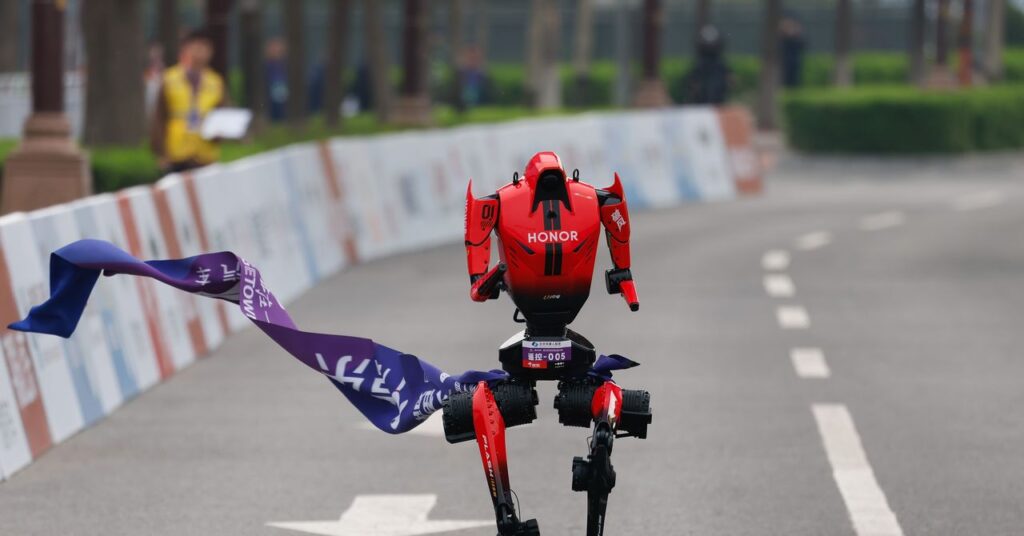
Over the weekend in China, a humanoid robot broke the world half-marathon record—the human record—by seven minutes.
The standout was a robot developed by the Chinese company Honor (the smartphone producer), which completed the 13.1-mile race in 50 minutes and 26 seconds. The human record, held by Ugandan Olympic runner Jacob Kiplimo, is 57 minutes and 20 seconds. This achievement is particularly remarkable considering that just a year prior, the fastest robot at this half-marathon took two and a half hours to finish the same distance.
However, Honor’s robot wasn’t the only one on the course. The event featured over 100 humanoid robots from 76 different institutions across China. They lined up next to 12,000 human contenders in Beijing’s E-Town, although they followed separate routes to minimize the risk of accidents. The performance contrast between humans and robots was striking.
Run, Robot, Run
A humanoid robot is designed to replicate the structure and movement of the human body, equipped with legs, arms, and sensors that enable interaction with its surroundings. The winning robot featured characteristics inspired by elite athletes: long legs (nearly a meter), sophisticated balance systems, and a liquid cooling mechanism, akin to those in smartphones, to prevent overheating during the race.
Additionally, many of the robots functioned autonomously, meaning they operated without direct human control. Utilizing artificial intelligence algorithms, they were able to adjust their speed, maintain balance, and adapt to the terrain in real-time. Notably, the Honor robot that clocked in at 50 minutes ran autonomously, while another robot, controlled remotely, completed the race even faster at 48 minutes and 19 seconds.
As anticipated, the race saw its share of mishaps. Some robots fell, others strayed off the track, and several required technical support. While the physical capabilities of humanoid robots have advanced quickly, their reliability remains a work in progress. Fortunately, the mockery and laughter are being replaced by applause and expressions of surprise.

Robot Superiority
Similar to the robots that gained fame for their impressive martial arts displays a few weeks ago, this long-distance competition is part of a larger initiative by China to showcase its leadership in advanced robotics technology.
You don’t need to be a robotics expert to recognize that this accomplishment illustrates machines outperforming humans in specific physical tasks under controlled conditions. (It’s unlikely that the winning robot would replicate this result if it rained during the race.) Nevertheless, humans retain advantages: Running in a straight line is fundamentally different from executing complex real-world tasks, such as manipulating delicate objects or social interaction.
However, it’s understandable that the image of a robot finishing the race in record time, ahead of human competitors, raises numerous questions. Is this the dawn of a new era where machines push physical boundaries?
One might argue that cars are machines, and they have always outpaced humans. Yet a humanoid robot is built to replicate human form. It’s more disconcerting to see one surpass humanity in its own arena—even if many still face tripping hazards.
This story originally appeared in WIRED en Español and has been translated from Spanish.

Rajat Sharma
https://in.linkedin.com/in/rajat-mediaHelping D2C Brands Scale with AI-Powered Marketing & Automation 🚀 | $15M+ in Client Revenue | Meta Ads Expert | D2C Performance Marketing Consultant