UK Space Startup Sends Longevity Laboratory into Orbit
Outer space is emerging as the next frontier in longevity research.
A British startup has initiated self-operating chemical experiments in orbit, aiming to leverage zero-gravity conditions to investigate a set of disease-related proteins that are challenging to analyze on Earth. However, their first step is to verify if their autonomous lab will function in space.
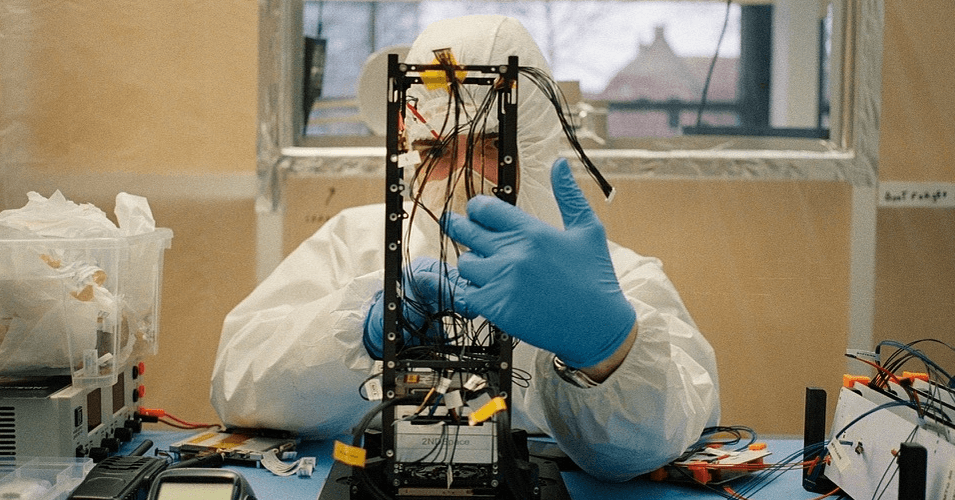
Mass Balance’s apparatus, about the size of a grapefruit and equipped with chemicals, sensors, and control elements for maintaining chemical activity, launched aboard a SpaceX vehicle on Tuesday morning. Housed in a 10-centimeter pod constructed by Austrian firm Tumbleweed, the experiment will circle the Earth for several months, automatically collecting and transmitting data on how living cells grow, respond, and operate in low gravity.
This represents the first trial of a system the company believes could produce high-quality data unachievable on Earth, where greater gravity brings about effects like convection and sedimentation, complicating data collection processes.
“When gravity is removed, many odd and fascinating phenomena occur, some of which could prove extremely valuable for life sciences and pharmaceuticals,” says Toby Call, co-founder and CEO of Mass Balance, in an interview. “While it may sound far-fetched today, the ultimate aim is to make space a routine, dependable research setting.”
This new research setting could be vital for imaging disordered proteins, which are linked to age-related conditions such as Alzheimer’s, Parkinson’s, and certain cancers.
On Earth, these proteins frequently change their shape, making imaging challenging. This poses a gap in the training data for life sciences models like Google’s AlphaFold, limiting their ability to predict the behavior of disordered proteins and their reactions to medications.
However, scientists are optimistic that certain disease-related disordered proteins may become easier to study and analyze in space. Call intends to generate data by conducting tests on these proteins under microgravity conditions and utilize it to train an AI model pipeline that addresses the data gaps—offering model, data licensing, and data access as revenue streams for his company.
At present, the company is focused on testing its operating system and data capturing method. The mission on Tuesday will send an industrial biocatalyst into space to decompose another chemical compound. The platform will observe the process with light to ensure the chemical reaction proceeds as expected.
Several other biotech startups are working on developing orbiting laboratories. In May, British company BioOrbit launched a test unit producing ultra-pure, stable crystals that can be formulated into injectable cancer treatments, while American-owned Varda Space Industries is similarly engaged in pharmaceutical processing in microgravity. Unlike these two companies, Mass Balance does not aim to retrieve its system intact, alleviating many of the significant engineering challenges associated with enduring the extreme heat and stress encountered during re-entry into Earth’s atmosphere.
“Microgravity represents an underutilized new tool,” states Call.

Rajat Sharma
https://in.linkedin.com/in/rajat-mediaHelping D2C Brands Scale with AI-Powered Marketing & Automation 🚀 | $15M+ in Client Revenue | Meta Ads Expert | D2C Performance Marketing Consultant