The Debate on AI Slowdown Disrupted Salesforce’s Celebration
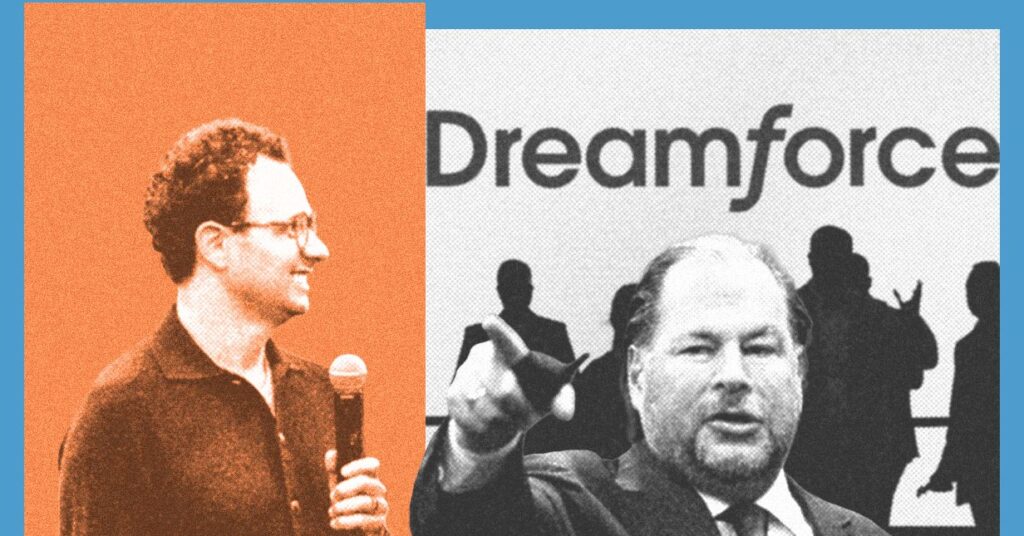
Dressed in purple and plaid, Gwen Stefani performed her 2002 hit “Underneath It All” to a full house at a San Francisco conference center on Tuesday morning—but she was just getting things started. At the end of her set, Stefani exclaimed “Dreamforce! Let’s go!” into a checkered microphone just before Salesforce CEO Marc Benioff took the stage. Dreamforce is touted as the largest enterprise software conference in the world, yet it often resembles a megachurch—especially this year.
Benioff navigated through the crowd as he delivered his Dreamforce keynote, trailed by a teleoperated camera that projected his image onto screens suspended from the cavernous ceiling. Within moments, he requested a graph showcasing Salesforce’s annual revenue, which is expected to exceed $46 billion by 2027, buoyed by the rising demand for its AI-driven products. The audience responded with applause. However, a pressing concern lingered: Is the pursuit of artificial intelligence worth putting our lives at risk?
During flashy software showcases of agents creating dashboards, attendees observed Silicon Valley leaders debate whether the AI industry should continue its rapid pace or if governmental intervention is necessary to mitigate catastrophic risks associated with the technology.
Recently, AI researcher Jacob Coxon resigned from Anthropic, publicly cautioning that companies hastening toward self-improving AI systems were “gambling with our lives.” Over the weekend, other Anthropic team members echoed his sentiments, and CEO Dario Amodei called on world leaders to help “pace the frontier” of AI development. This notion gained traction among other AI CEOs, including Amodei’s top rival, OpenAI’s Sam Altman.
Not everyone shares this perspective, however. David Sacks, an AI adviser in the White House, dismissed Amodei’s concerns about potential AI dangers as “just another bid for regulatory capture.” This week, President Trump took it a step further, labeling fears about existential AI risk “a hoax.” Amid this complex political landscape, Congress is attempting to seize the moment by advancing legislation aimed at regulating the AI industry.
Onstage, the towering 6-foot-5 Benioff shook hands vigorously with Anthropic’s CEO just before inquiring about his latest views on AI progress. While it’s clear that this event revolves around Benioff, Anthropic has emerged as a key ally in guiding Salesforce into the age of AI.
“Imagine running a car company and another, not yours, faces a safety issue,” Amodei remarked, alluding subtly to OpenAI’s Hugging Face episode. “It’s easy to want to attack your rival,” he continued, but the more prudent approach is to “organize the entire industry and determine what standards we can establish for everyone.”
Still, the Anthropic CEO emphasized that pacing the frontier doesn’t imply “freezing the technology,” and he took a moment to promote Claude’s integration with Salesforce.
Shortly after Amodei left the stage, Nvidia CEO Jensen Huang appeared, downplaying the concerns raised by Anthropic. He argued that AI safety essentially boils down to an “engineering problem,” asserting that AI companies can self-regulate.
“We don’t require new laws or regulations,” Huang told attendees at Dreamforce. “You move as quickly as you can, but if at any moment you feel the company is out of control or the products are unsafe, you pause.”
While this debate may seem intense for Dreamforce, perhaps it is the ideal setting for such discussions. As tech executives showcased their various enterprise AI solutions, I slipped out of the room, navigating past the plush mascots and loosely Hawaiian decorations, to take a call from Sayash Kapoor, an incoming computer science professor at UC Berkeley.

Rajat Sharma
https://in.linkedin.com/in/rajat-mediaHelping D2C Brands Scale with AI-Powered Marketing & Automation 🚀 | $15M+ in Client Revenue | Meta Ads Expert | D2C Performance Marketing Consultant