I’ve Reported on Robots for Years, but This One Stands Out.
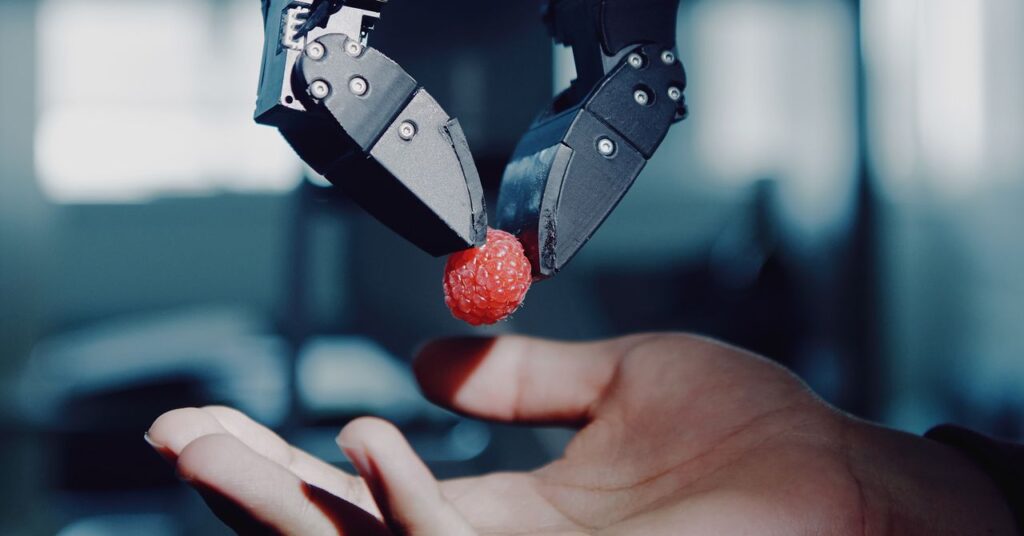
Handling food remains a predominantly human-centric task. Fresh produce, meats, and various other items require prompt yet gentle management. Automation proves challenging as each piece of fruit, vegetable, or chicken nugget varies in appearance.
Eka’s demonstrations imply that the company may be on the verge of significant advancements. I found myself drawing parallels between their robots and GPT-1, OpenAI’s initial large language model, created four years prior to ChatGPT. GPT-1 often lacked coherence but hinted at an emerging understanding of language.
The robots I observed exhibited a similar budding physical intelligence. Watching a video of one reaching for keys in slow motion, I noted its surprisingly human-like behavior: it brushed its gripper tips against the table, gliding along the surface before interacting with the keys and securing them. Eka’s algorithms appear adept at intuitively recovering from mistakes—an aspect that poses challenges for other robots unless trainers intentionally introduce various errors.
Unlike with any other robot I can recall, it’s almost conceivable to understand the robot’s perspective. Its sensors seemingly register the weight of its arm, the inertia as it extends toward the keys and decelerates. After grasping the keys, it appears to gauge their weight as they dangle from its grip.
I’m unsure if Eka’s method truly represents the path toward a ChatGPT-like revolution in robotics. Some knowledgeable experts contend that combining human demonstration with simulation will yield superior outcomes compared to simulation alone. Perhaps a blend of both techniques will ultimately be essential? However, it’s evident that for robots to achieve human-like dexterity, they must develop the tactile, physical intelligence that Eka is pioneering.
Agrawal informs me that this overarching strategy should also facilitate more precise manipulation. The intricate dexterity required for tasks like assembling an iPhone could be accomplished by designing varied actuators and sensors and honing the skill through simulation.
After spending a few hours at Eka, I decide to visit the restaurant downstairs. Observing from the counter, I watch the staff prepare meals and brew coffee. A future version of the machine upstairs might replicate these tasks as well, if not more efficiently. Yet, considering how much I appreciate interacting with the staff, I would likely pay more to keep humans in the equation—unless, of course, automation overtakes my own role.
What Say You?
We invite you to share your thoughts on this article in the comments below. Alternatively, you may submit a letter to the editor at [email protected].

Rajat Sharma
https://in.linkedin.com/in/rajat-mediaHelping D2C Brands Scale with AI-Powered Marketing & Automation 🚀 | $15M+ in Client Revenue | Meta Ads Expert | D2C Performance Marketing Consultant