Is AI Set to Supplant Nuclear Agreements? Feeling Anxious?
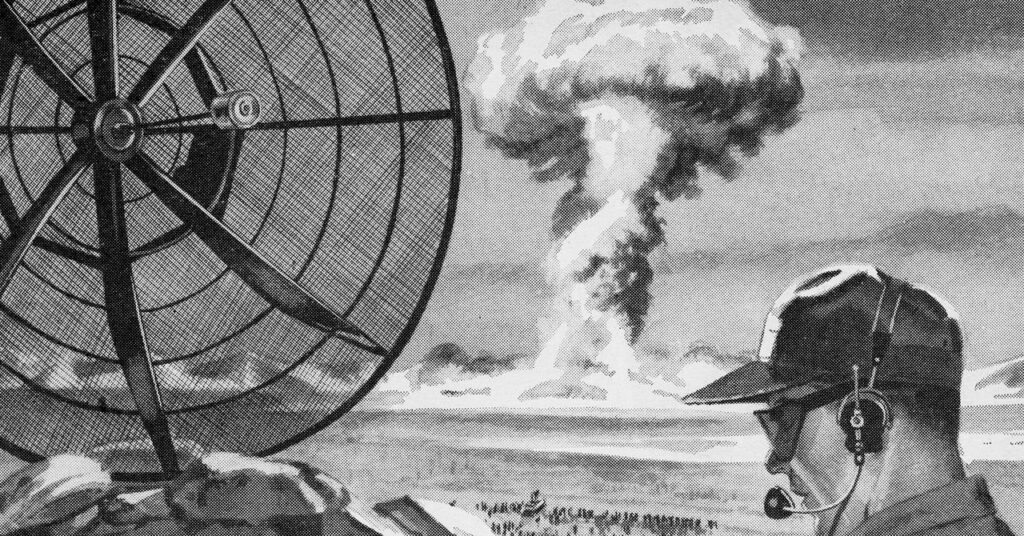
For fifty years, the world’s nuclear nations depended on a complex web of agreements that gradually decreased the number of nuclear arms globally. Those agreements have now vanished, and their return seems unlikely in the near future. As a temporary solution, researchers and scientists are proposing an innovative and unconventional approach: employing satellites and artificial intelligence to oversee the globe’s nuclear arsenal.
“This is essentially plan B,” says Matt Korda, an associate director at the Federation of American Scientists, in a conversation with WIRED. Korda has authored a report at FAS outlining a prospective future for arms control in a context where previous treaties no longer exist. In Inspections Without Inspectors, Korda and co-author Igor Morić unveil a novel method for monitoring the world’s nuclear arms, which they term “cooperative technical means.” Essentially, satellites and various remote sensing technologies would assume the roles once occupied by scientists and inspectors on-site.
Korda suggests that AI could enhance this endeavor. “Artificial intelligence excels in pattern recognition,” he remarks. “Given a sufficiently large and well-organized dataset, one could hypothetically train a model capable of detecting subtle changes at specific locations, as well as identifying individual weapon systems.”
The New START treaty, established during the Obama administration to limit the nuclear arsenals of the United States and Russia, expired on February 5. (Rest assured, both nations reportedly intend to maintain the current situation—for the time being.) Both countries are investing billions in developing new and diverse nuclear weaponry. China is constructing additional intercontinental ballistic missile silos. As America steps back from global leadership, its nuclear guarantees are losing significance, prompting nations like South Korea to consider nuclear options. Trust among countries is at an unprecedented low.
In this context, Korda and Morić propose utilizing existing infrastructure to negotiate and implement new treaties. “No nation desires ‘on-site inspectors traversing their land,’” Korda explains. Thus, in the absence of that, nuclear powers can leverage satellites and remote sensors to oversee the world’s nuclear arsenal from afar. AI and machine-learning systems would process this data, organize it, and submit it for human analysis.
Although it’s not a perfect solution, it’s an improvement compared to the current state of nothing.
For many years, the US and Russia have aimed to diminish the global nuclear stockpile. In 1985, the count exceeded 60,000 warheads. Now, that number stands at just over 12,000. The elimination of nearly 50,000 nuclear weapons required decades of concerted efforts from politicians, diplomats, and scientists. The expiration of New START signifies a repudiation of that extensive work. These inspections were crucial in building trust between Russia and the US, laying a foundation for a reduction in Cold War tensions. That era has ended, giving way to a period marked by hostility and a renewed nuclear arms race.
“The concept we explored in this paper was what if there exists a compromise between lacking arms control and mere surveillance, versus having arms control that necessitates intrusive on-site inspections, which may no longer be politically feasible?” Korda inquires. “What capabilities could we harness remotely if the nations were willing to collaborate on a remote verification system?”
Korda and Morić’s initiative aims to utilize the existing network of satellites to observe intercontinental ballistic missile (ICBM) silos, mobile missile launchers, and plutonium production facilities. A significant challenge is that a successful remote enforcement treaty would require a level of cooperation; nuclear powers would still have to consent to participate.

Rajat Sharma
https://in.linkedin.com/in/rajat-mediaHelping D2C Brands Scale with AI-Powered Marketing & Automation 🚀 | $15M+ in Client Revenue | Meta Ads Expert | D2C Performance Marketing Consultant