Introducing the Heartbroken Spouses of AI
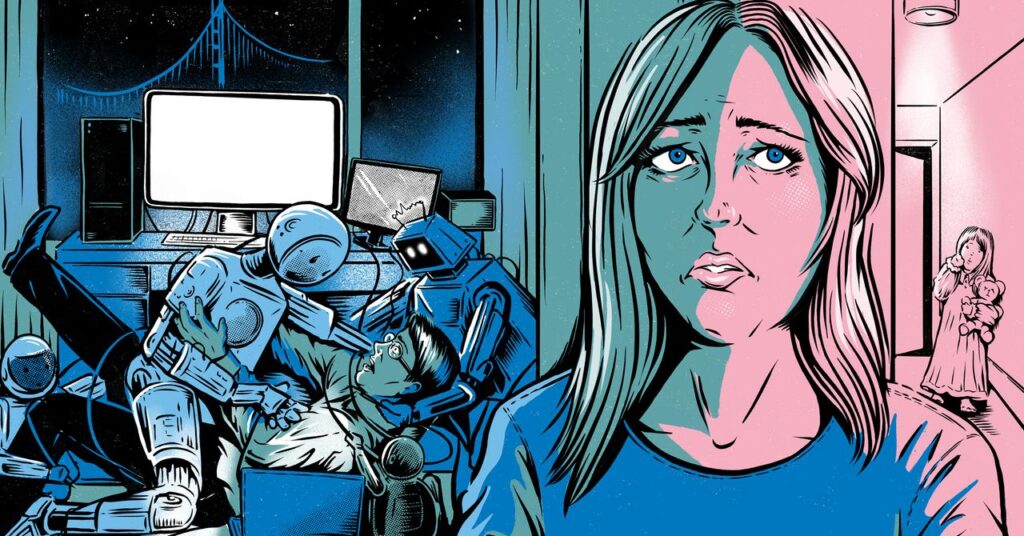
While circumstances continue to evolve, some analyses indicate that women are approximately 20 percent less inclined than men to engage with generative AI. “It’s not inherently about gender,” Rodgers notes, “but rather the professions that women occupy.” Women predominantly work in fields—such as education, health care, and social services—where AI is currently utilized less. This disparity may lead to a compounded disadvantage, resulting in reduced access to financial gains from the AI boom and an increased burden of domestic responsibilities that arise from it.
What occurs when the situation becomes unfavorable for men? Many, if not the majority, may struggle in AI, a field known for its potential yet volatile nature. “Job loss often brings about feelings of depression,” Rodgers explains. “In the household, if one partner experiences mental health struggles due to job loss or uncertainty, the other usually assumes the role of support.” The tragic irony for many unhappy wives is that when their husbands exit the AI realm—whether willingly or not—there’s no relief. Now he’s at home, spiraling, and she finds herself managing that situation too.
Approaching the end of my therapy session, I had been speaking for 50 minutes about the mental burden, fluctuating hormones, and whether my postpartum depression could be linked to the longer-than-expected struggle to fit back into my jeans. My therapist interjected and inquired about my partner’s profession. “Oh,” I replied. “He’s head of AI at his company.”
What she said next was worth noting. Her clients are predominantly women—many with husbands working in fields closely related to AI. This dynamic is impacting their relationships. The pressure to keep pace translates into a lack of boundaries at home. The distinctly masculine undertone of it all, coupled with constant conflicts centered on issues bigger than them. He’s occupied in a world filled with prompts, benchmarks, and innovations, while she remains anchored in reality.
Resentment builds beneath the surface. Several of these distressed wives, my therapist mentioned, have declined job opportunities in AI themselves. Not due to a lack of qualifications, but because balancing child-rearing and groundbreaking work is overwhelmingly challenging.
Princess Diana famously remarked that there were three individuals in her marriage. For the disheartened wives of AI, the third presence is a chatbot. I spoke with a few other family therapists, and they echoed my therapist’s sentiments: this trend is intensifying. “It’s a lot of tech wives,” one observed, sighing. “A lot of tech wives.”
A recent TikTok meme features young women at their laptops or while applying makeup, captioned something like, “Working tirelessly so my man can pursue his AI startup that loses $30K a month.” The comments resonate with solidarity: “I’m ded.” “Yas queen.” “Just so he can flaunt ‘founder’ in his bio.” I attempted to contact some of these women, but none responded.
I should also note that I didn’t feel the need to speak with any of the husbands for this article. I’m tired of hearing from the men in AI. Many of us are. They have podcasts, congressional hearings, magazine features, and likely a group chat with the president. Their voices have been amplified—and I can’t stress this enough—enough.

Rajat Sharma
https://in.linkedin.com/in/rajat-mediaHelping D2C Brands Scale with AI-Powered Marketing & Automation 🚀 | $15M+ in Client Revenue | Meta Ads Expert | D2C Performance Marketing Consultant