AI Leaves Human Doctors Wondering: What Role Remains for Us?
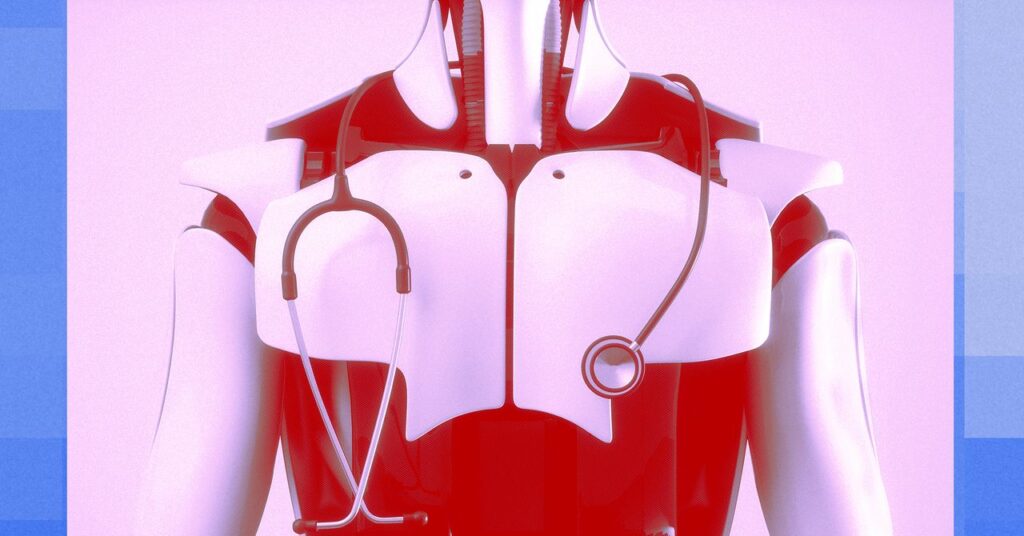
Don’t be misled by the question mark in the title of a recent article published in the Journal of the American Medical Association. When the authors, including prominent figures like Ezekiel Emanuel and Vinod Khosla, posed the question, “Will Autonomous AI Exceed AI-Physicians as the Best Medical Care?” they were being rhetorical. Their response is a resounding YES. Many in the healthcare sector are reluctantly acknowledging that the optimal treatment for patients may involve a hybrid strategy where doctors collaborate with advanced bots. However, the central argument of this article is that AI independently can achieve the best outcomes.
“An analysis of all published literature on AI in medicine since January 1, 2024, indicates that the field is nearing a pivotal moment when AI alone will surpass both physicians and physician-AI hybrids in delivering top-tier care across five essential medical functions,” they assert. These functions encompass gathering medical histories, making diagnoses, determining necessary tests, prescribing treatments, and managing chronic conditions. In essence, doctoring. They contend that AI has advanced to such a degree that healthcare providers should step back, as “humans in the loop degrade AI performance.” It’s time to let AI take the reins, a role that traditionally belonged to you.
Lead author Emanuel—who is the brother of Ari and Rahm, chairs the Department of Medical Ethics and Health Policy at Penn, and is a respected oncologist—confided in me that for many years, he dismissed the idea that AI could execute fundamental medical tasks. He often encountered Khosla at conferences during the 2010s, where the VC would passionately discuss his belief that AI would handle 85 percent of what doctors do by 2035. Khosla had long championed this idea, writing a 2012 article in TechCrunch titled, “Do We Need Doctors or Algorithms?” (once again, rhetorical) and producing a 101-page analysis in 2016 along similar lines. “I thought it was nonsense, there’s no way,” Emanuel remarks. “What doctors do is far too complex.”
However, about a year ago, Emanuel’s colleague Robert Wachter shared drafts of his book A Giant Leap, where Wachter, who leads the medicine department at UCSF, envisioned a future where top-quality care involves collaboration between AI and physicians, while the general population in “economy class” would primarily rely on AI alone. This sparked a shift in Emanuel’s thinking about Khosla’s assertions. He was confronted with a daunting inquiry: “If AI takes the lead, what will be left for physicians?”
To substantiate this premise, he sought Khosla’s partnership, and the VC recommended that his son Neal Khosla join their efforts, along with one of Emanuel’s researchers. Neal operates Curai Health, a digital platform that employs AI for patient treatment, supported by a team of doctors for prescriptions and more complex matters. (This potential conflict of interest is acknowledged in the paper, in addition to Vinod Khosla’s investments and Emanuel’s various grants and consulting roles.) The co-authors set out to examine all relevant studies on AI in medicine from January 2024 to the present and concluded that in numerous instances, a “superior autonomous AI” is likely to outshine humans utilizing AI by 2030. They acknowledge that this forecast is “unsettling but appears likely.”
Unsettling is an understatement. Among the most vocal critics is John Whyte, CEO of the American Medical Association, representing the physicians who will be grappling with these changes. In our conversation, Whyte highlighted perceived deficiencies in the paper, including that some of the studied cases were simulations rather than blind experiments, and not all supported the article’s conclusions. Notably, a February 2026 article in Nature revealed that in real-world scenarios, most patients struggled to effectively interact with large language models to leverage their expertise. Whyte was understandably resistant to the notion of excluding humans from the clinical decision-making process. “The AMA recognizes the potential of these tools, but they must be applied within a care framework overseen by a physician,” he states.

Rajat Sharma
https://in.linkedin.com/in/rajat-mediaHelping D2C Brands Scale with AI-Powered Marketing & Automation 🚀 | $15M+ in Client Revenue | Meta Ads Expert | D2C Performance Marketing Consultant