The Tiny English Town Caught in the Global AI Competition
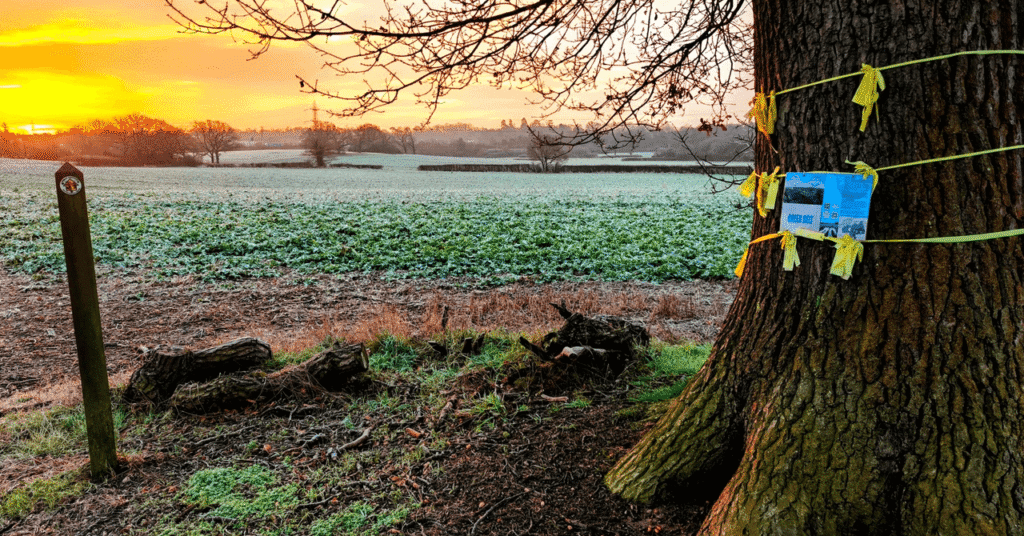
A brief journey from London, Potters Bar is set apart from South Mimms by 85 acres of picturesque farmland divided by a maze of hedgerows. In one of the fields, a solitary oak stands as a rest point along a public footpath. Recently, this tree has also become a site of protest. A notice attached to its trunk declares: “NO TO DATA CENTRE.”
In September 2024, a property developer sought authorization to construct an industrial-scale data center—one of Europe’s largest—on the farmland. Once locals became aware, they established a Facebook group aiming to halt the project. Over 1,000 individuals joined.
The local government has thus far disregarded the group’s grievances. In January 2025, it granted planning approval. The following October, multinational datacenter operator Equinix secured the land; construction is planned to commence this year.
On a dreary Thursday afternoon in January, I gathered at a gate leading onto the farmland with Ros Naylor—one of the Facebook group’s administrators—and six other residents. They expressed their objections to the data center for various reasons, emphasizing the loss of green space, which they view as an essential pathway from town to countryside and a buffer against the highway and fuel station visible in the distance. “The beauty of walking in this area lies in traversing this space,” Naylor states. “It’s vital for mental health and wellbeing.”
As the UK government races to satisfy the immense demand for data centers needed to train AI models and support AI applications, similarly large facilities are projected to rise across the country. However, for those living nearby, the notion that AI might boost the economy or enhance their smartphones offers little solace for what they perceive as a disruption to their rural lifestyle.
Elimination of Red Tape
Since the mid-20th century, London has been surrounded by a nearly continuous expanse of land known as the green belt, comprised of farms, forests, meadows, and parks. Under UK legislation, construction is only allowed on green belt land in “very special circumstances.” This policy aims to safeguard rural areas from urban sprawl and prevent neighboring towns from merging into a vast urban landscape.
However, following the current government’s ascension to power in 2024, the UK introduced a new land classification—grey belt—to categorize underperforming segments of the green belt where development should be more easily allowed. Around the same time, officials announced that data centers would be regarded as “critical national infrastructure.” These shifts have facilitated the construction of numerous new data centers across the UK.
As they strive to create models that can exceed human intelligence, the world’s largest AI laboratories plan to invest trillions of dollars in infrastructure. Globally, wherever new data centers are established, developers face organized opposition from affected communities.
When the local planning authority sanctioned the Potters Bar data center, its officials determined that the farmland met the criteria for grey belt. They noted that their decision was influenced by the government’s backing of the data center sector. The advantages of infrastructure development and economic growth, they concluded, outweighed the loss of green space.
“People often harbor a somewhat romantic notion that all green belt land consists of untouched, rolling green fields. In reality, this site, like many others, is far from that,” remarks Jeremy Newmark, leader of Hertsmere Borough Council, which includes Potters Bar. “It’s a patch of very low-performing green belt land.”

Rajat Sharma
https://in.linkedin.com/in/rajat-mediaHelping D2C Brands Scale with AI-Powered Marketing & Automation 🚀 | $15M+ in Client Revenue | Meta Ads Expert | D2C Performance Marketing Consultant