AI Has Died. Organoids Are Thriving.
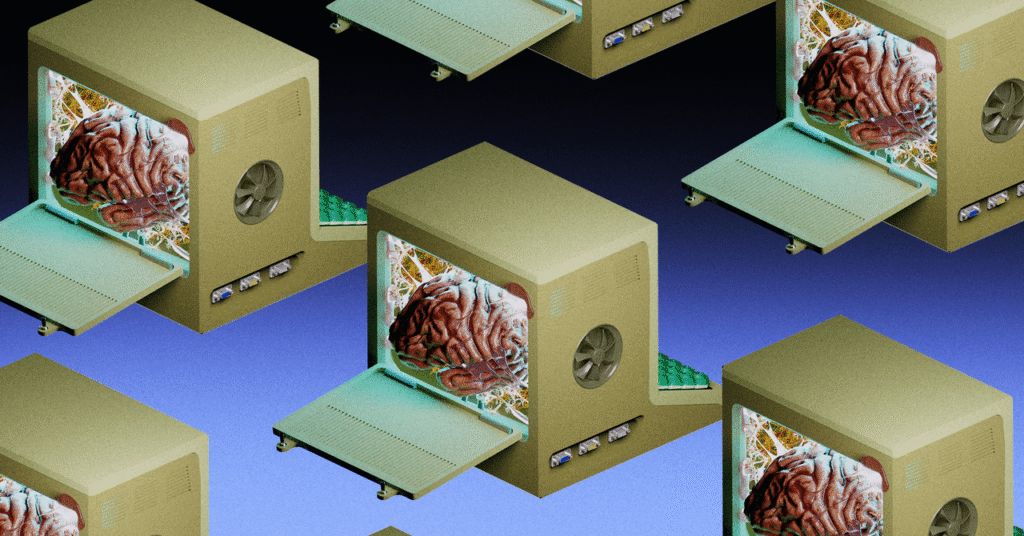
I’m about to share an intriguing insight with you. Every cell in your body possesses the potential to become smarter. This isn’t a metaphor or a vague notion; if biologists in lab coats were to extract a sample of your skin and meticulously manipulate the cells within, they could indeed create a brain. They do it regularly.
While it wouldn’t be as complex as the one inside your skull, it would still be a mass of gray matter, containing a few million neurons capable of transmitting and receiving electrical signals. These peculiar creations are known as human brain organoids. When maintained at a cozy 98.6 degrees Fahrenheit for eight months, they generate repetitive oscillations—brain waves—that closely resemble those of a premature infant.
In cell culture laboratories worldwide, human brain organoids serve as neural test subjects, examining the impacts of diseases, toxins, and new drugs. However, they may soon embark on more thrilling adventures. At the University of San Diego, these organoids are leading intricate robots through mazes and experiencing substantial doses of psychedelics. At Johns Hopkins, they are laying the groundwork for innovative biocomputing systems. Meanwhile, a startup in Melbourne is having them play video games like Pong and Doom.
Biologists are quite the pioneers. While many of us are captivated by large language models and AI systems, they are delving straight into the essence of intelligence, nurturing live neurons and learning to manipulate them with electrical signals and doses of dopamine. They predict that in the future, artificial intelligence won’t be artificial at all; it will be derived from the very essence of life.
The most striking building at UC San Diego is the library. An inverted concrete ziggurat, the Geisel Library—named after the beloved children’s author Dr. Seuss—dominates an otherwise serene campus on slender, two-story columns. On a recent afternoon, with a marine layer settling over the eucalyptus trees, it resembled the mothership of a brutalist extraterrestrial race.
That day, the sunken lobby of the Geisel showcased scientific images from the university’s collection. Amid CGI representations of folded proteins and macrophotographs of deep-sea creatures, one image stood out. It depicted a cluster of human brain cells, silhouetted against the bright white background of a petri dish. A halo of axons, the threadlike nerve fibers that transmit electrical signals within the brain, extended outward from the cluster with a sense of yearning.
Whether nestled in our skulls or contained in a dish, neurons are driven by a desire to connect with one another—and to create synapses that enable the electrical exchanges that underpin thought. They excel at this. When brain cells are gathered, they will proliferate and intertwine, forming cohesive clusters of tissue. Human brain organoids almost assemble themselves.
Just a 20-minute stroll from the Geisel, at UCSD’s Sanford Stem Cell Institute, they are producing these organoids by the tens of thousands. “In any environment, their first instinct is to connect,” said Brazilian developmental biologist Alysson Muotri as we looked out at the blue expanse of the Pacific beyond his office window. “They seek to connect with the dishes, the electrodes, and each other. This is an intrinsic aspect of our brain: the urge to connect.”
Muotri is charismatic, sporting a surfer’s tan and the refined profile of a figure from ancient Rome. Over the last decade, his laboratory has significantly broadened the horizons of brain organoid research. He and his team have revived genetic material from ancient hominins to produce “Neanderthalized” brain organoids. They have even sent organoid samples to the International Space Station to examine the effects of cosmic radiation on astronauts’ brains. However, the matter closest to Muotri’s heart is autism. His 18-year-old son is autistic and requires round-the-clock care. By investigating brain organoids derived from the cells of autistic donors—including his son—he aims to identify how the neural development of autistic children diverges from that of neurotypical children.

Rajat Sharma
https://in.linkedin.com/in/rajat-mediaHelping D2C Brands Scale with AI-Powered Marketing & Automation 🚀 | $15M+ in Client Revenue | Meta Ads Expert | D2C Performance Marketing Consultant