How a Startup Created a Robot Largely Free of Chinese Components
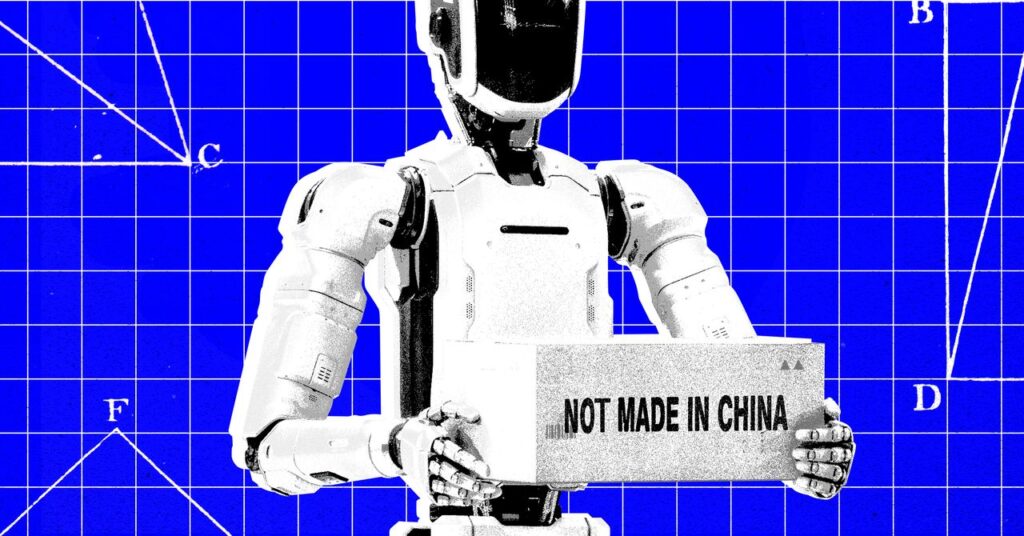
Recently, US regulators prohibited the import of various Chinese-manufactured robots due to national security concerns. Saurabh Chandra was eager to act on this opportunity. His firm, Ati Robotics, assembles its robots in India, and Chandra believes they incorporate fewer Chinese components than nearly any other robotics company in the US.
According to PitchBook, which monitors venture capital trends, investment in robotics startups reached unprecedented levels this year, in both the number of deals and total funding. However, many of these firms mainly focus on software development and predominantly depend on Chinese suppliers for hardware.
The Federal Communications Commission’s recent decision to ban new humanoid robots and other sophisticated devices from China could potentially hinder the growth of numerous smaller robotics companies in the US. Yet, some businesses, including Ati, may find opportunities.
Founded in 2017 to create motors for self-driving vehicles, the startup later shifted focus to manufacturing its own robots, such as tuggers and pallet movers that transport substantial materials within large facilities. Ati invested in developing its own hardware, anticipating improved functionality, a decision that Chandra says many advisors warned against but ultimately minimized dependence on China.
This strategy is beginning to bear fruit. Ati currently operates several hundred robots across warehouses and factories, serving more than 50 customers, according to Chandra. The company’s first humanoid robot, designed to move heavy bins, is set to launch later this year.
Chandra discussed with WIRED last week how Ati Robotics avoided reliance on China while creating robots that he claims can compete effectively in terms of cost and performance.
This interview has been edited for clarity and brevity.
WIRED: Creating hardware is costly. How did you manage to finance this endeavor?
Saurabh Chandra: R&D is based in Bangalore, which aids our labor expense management. Bangalore was experiencing a surge in electric vehicle production within the two-wheeler and three-wheeler categories in India. Interestingly, the vehicles we were developing for the robotics sector shared similar power characteristics as those electric vehicles.
We aimed to utilize the components and supply chain that were emerging for those vehicles. Generally, automotive parts are highly reliable and produced in large quantities, making them both effective and cost-efficient. Although we had to engineer some components with vendors to adapt them for robotic use, once we achieved that, it was a significant success.
One of your robot models is free from Chinese parts, right? What about the others?
They possess varying degrees of what I refer to as “supply chain resiliency.” Two of our top-selling models—the 10,000-pound tugger and the pallet mover—contain very few components sourced from China. They’re designed to transport raw materials, whether from storage to the production line or between different process stages.
Even with the humanoid robot, the complete arm is manufactured in Bangalore. The actuator is also produced here, but we currently source the harmonic drive from China, as well as the frameless motor.
The battery cells are imported from China, but we could easily acquire them from South Korea or Japan if needed. These are passive components. There are some parts that we do source from China for more complex needs. We utilize induction motors, and even the motor’s magnet is sourced from elsewhere, which distinguishes us from many others in the robotics field.

Rajat Sharma
https://in.linkedin.com/in/rajat-mediaHelping D2C Brands Scale with AI-Powered Marketing & Automation 🚀 | $15M+ in Client Revenue | Meta Ads Expert | D2C Performance Marketing Consultant