China Launches the World’s First Underwater Data Center Fueled by Wind Energy
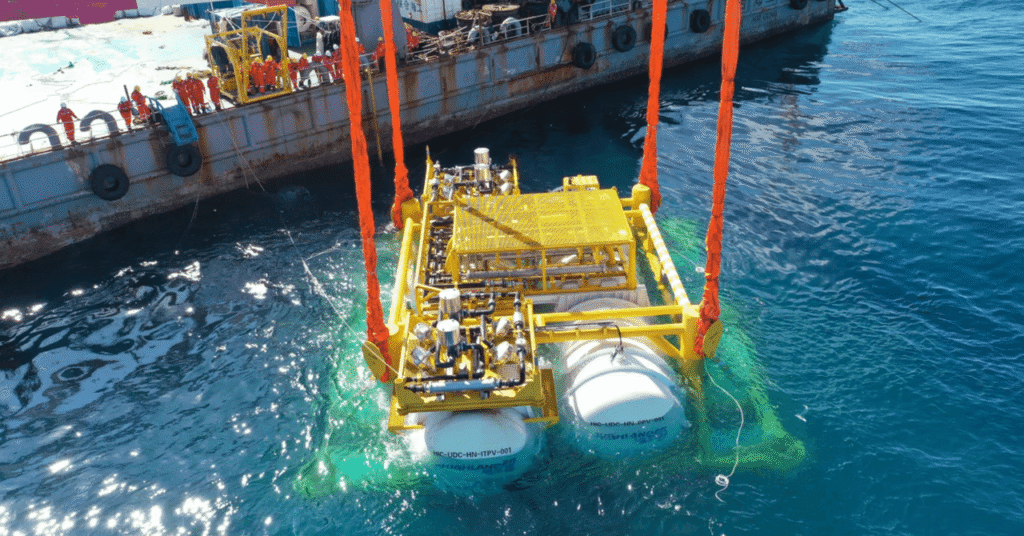
China has emerged as the first nation worldwide to run an underwater data center, or UDC, powered by wind energy. Situated off the coast of Shanghai, this complex marks a major milestone in the country’s strategy to secure energy resources amid the rapid expansion of artificial intelligence, while also decreasing reliance on fossil fuels and minimizing the environmental footprint of its technological infrastructure.
This initiative stems from a partnership between the private firm HiCloud Technology and the state-owned China Communications Construction, involving an investment of 1.6 billion yuan, around $236 million.
With an initial capacity of 24 megawatts, the facility is submerged to a depth of 10 meters in the Lin-gang Special Zone, which is part of the China Pilot Free Trade Zone in Shanghai. This strategic location allows for the utilization of seawater as a natural cooling method, cutting down the energy required for cooling to under 10 percent.
This characteristic addresses one of the key energy consumption issues faced by traditional data centers, where air conditioning typically represents 40 to 50 percent of overall electricity usage.
The thermal efficiency of the UDC is directly reflected in its power-usage effectiveness, or PUE. This industry metric measures the energy performance of a data center, with 1.0 indicating the highest theoretical efficiency. In its initial phase, the Lin-gang facility is engineered to achieve a PUE of no more than 1.15, a benchmark considered cutting-edge in the industry.
Following the same cooling principle, HiCloud inaugurated the world’s first commercial underwater data center in 2023 in Hainan, a southern Chinese island. Nevertheless, the Shanghai facility stands out as the first to harness offshore wind power.
Construction of the UDC reached completion in mid-October last year. According to the Chinese government, “relative to conventional onshore data centers, this project is designed to utilize over 95 percent renewable electricity, cutting energy consumption by 22.8 percent, and reducing water and land usage by 100 percent and more than 90 percent, respectively.”
The launch of this complex is a significant advancement in China’s pursuit of optimizing energy supply through renewable sources, while concurrently maintaining its lead in computational capacity related to AI development.
A recent report from the UN indicates that merely 32 countries house data centers specialized in artificial intelligence. Of this global infrastructure, roughly 90 percent is concentrated in two nations: China and the United States.
Both countries are making efforts to secure the energy required for AI development, albeit through differing strategies. While the U.S. has scaled back investments and proposals associated with the energy transition, China aims to lessen its dependence on fossil fuels to achieve its climate objectives and reduce vulnerability to external suppliers.
In this context, Beijing’s energy self-sufficiency strategy stands out. As the world’s largest energy consumer, the nation is investigating technologies, including the use of materials like thorium and bismuth, alongside the rapid growth of renewable energies and nuclear power.
Last year, a new energy law was enacted, prioritizing the advancement of renewable sources and hydrogen to decrease dependency on fossil fuels while bolstering national energy security. This legislation also mandates authorities to establish minimum consumption targets for clean sources.
Simultaneously, the country initiated a comprehensive reform of its electricity market. By June 2025, all solar and wind energy must be traded through market mechanisms or auctions, gradually phasing out the previous feed-in tariff systems. These measures, along with financial incentives and the removal of legacy subsidies, aim to stimulate investment in clean technologies and enhance the efficiency of the energy system.
China’s transition to renewable energy is not solely motivated by environmental factors. It is also part of a long-term economic and geopolitical strategy aimed at strengthening its technological and industrial independence. In this light, the unveiling of the UDC marks a pivotal advancement, solidifying the nation’s position in comparison to the United States and the global landscape in the quest to develop infrastructure for the next wave of artificial intelligence and other technological innovations.
This article originally appeared on WIRED en Español and has been translated from Spanish.

Rajat Sharma
https://in.linkedin.com/in/rajat-mediaHelping D2C Brands Scale with AI-Powered Marketing & Automation 🚀 | $15M+ in Client Revenue | Meta Ads Expert | D2C Performance Marketing Consultant