OpenAI’s Greg Brockman Shares His Fear of Elon Musk Attacking Him
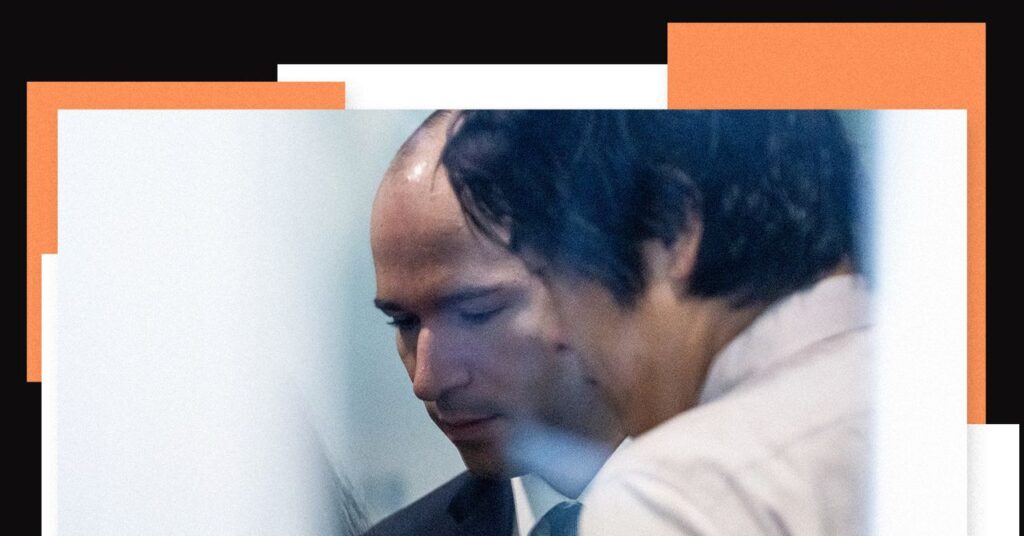
In August 2017, Greg Brockman and Ilya Sutskever convened at Elon Musk’s self-described “haunted mansion,” a sprawling 47-acre estate valued at $23 million in Hillsborough, south of San Francisco, to discuss the trajectory of OpenAI. Amber Heard, Musk’s then-girlfriend, served whiskey to the group and quickly left with a friend, as Brockman, OpenAI’s cofounder and president, recounted in federal court during the Musk v. Altman trial on Tuesday.
Before the meeting, Musk gifted Brockman and Sutskever, OpenAI’s cofounder and former chief scientist, brand-new Tesla Model 3 cars. “It felt like he was trying to sweeten us up,” Brockman stated during his testimony. “He wanted us to feel a sense of obligation.” To reciprocate, Sutskever, an amateur artist, presented Musk with a painting of a Tesla. While Musk and the other cofounders aimed to create a for-profit arm to attract billions in investment for computing expenses, Musk also sought control over the company. Sutskever and Brockman resisted granting the Tesla CEO what they perceived as a potential “dictatorship” over AI’s future and suggested shared governance instead.
After a brief deliberation, Musk dismissed their proposal. “He stood up and stormed around the table,” Brockman remembered. “I genuinely thought he was going to physically attack me.” According to Brockman’s testimony, Musk seized the painting, threatened to withdraw his funding from the nonprofit until both Brockman and Sutskever resigned, and exited the room. However, later that night, Musk’s so-called chief of staff, Shivon Zilis, contacted Brockman and Sutskever, saying, “It’s not over.” Brockman testified that “there were discussions of futures that included us.”
This account of intense negotiations surfaced as Brockman concluded his testimony on Tuesday. For OpenAI, the incidents at the mansion exemplify Musk’s pattern of unpredictable behavior that they believe undermines his claims regarding the company. Musk asserts that his $38 million in contributions to OpenAI were misused by Brockman and others, paving the way for the current $852 billion for-profit venture recognized for services like ChatGPT and Codex. Brockman, OpenAI CEO Sam Altman, and OpenAI deny any misconduct, and the jury in Musk v. Altman may start deliberating an advisory ruling as early as next week.
Following Tuesday’s testimony, William Savitt, OpenAI’s attorney, shared with reporters that Brockman’s 2017 experience illustrated how challenging it can be to meet one’s idols. While Brockman admired Musk’s business savvy, Savitt stressed that Musk’s unyielding quest for control was troubling. Marc Toberoff, Musk’s attorney, highlighted concerns over Brockman’s motivations for seeking shared governance, questioning his desire for wealth that had been scrutinized in court just a day prior.
Brockman also recounted another incident on Tuesday to emphasize his belief that Musk wasn’t fit to lead an AI company. He recalled then-OpenAI researcher Alec Radford presenting Musk with an early iteration of an AI chatbot that didn’t meet Musk’s expectations. Musk reportedly kept insisting the system was “so stupid” that a child on the internet could perform better. This left Radford feeling “absolutely crushed” and “demoralized” to the extent that he considered leaving the AI research field altogether. Brockman noted that he and Sutskever “dedicated a lot of time” to help restore Radford’s confidence. In Brockman’s view, Musk’s failure to recognize the potential of the early technology—which ultimately laid the groundwork for ChatGPT—rendered him unqualified to lead OpenAI. “You needed to dream a little bit,” Brockman stated, asserting that Musk had not demonstrated that ability.
Boardroom Fights
On Tuesday, Brockman revealed that he, Sutskever, and Altman had contemplated voting Musk off the nonprofit board of OpenAI as negotiations with him about a for-profit affiliate stretched on for months. They continued to meet over whiskey at Musk’s mansion to explore alternative funding avenues. While there was consensus on what not to pursue, they struggled to find actionable alternatives. Nevertheless, Brockman and Sutskever felt removing Musk was “wrong,” as Brockman testified. Eventually, Musk departed voluntarily after concluding that OpenAI was destined for “certain failure,” as he conveyed in an email from early 2018.
Zilis, who was then an adviser to both OpenAI and Musk, kept him updated on the developments of the AI venture in the years to follow. “She was a proxy for Elon in some respects,” Brockman said, referring to her as “a friend” whom he had first met around 2012 or 2013.

Rajat Sharma
https://in.linkedin.com/in/rajat-mediaHelping D2C Brands Scale with AI-Powered Marketing & Automation 🚀 | $15M+ in Client Revenue | Meta Ads Expert | D2C Performance Marketing Consultant