More Mistakes, Less Punctuation: Authors Are Forming an Anti-AI ‘Literary Rebellion’
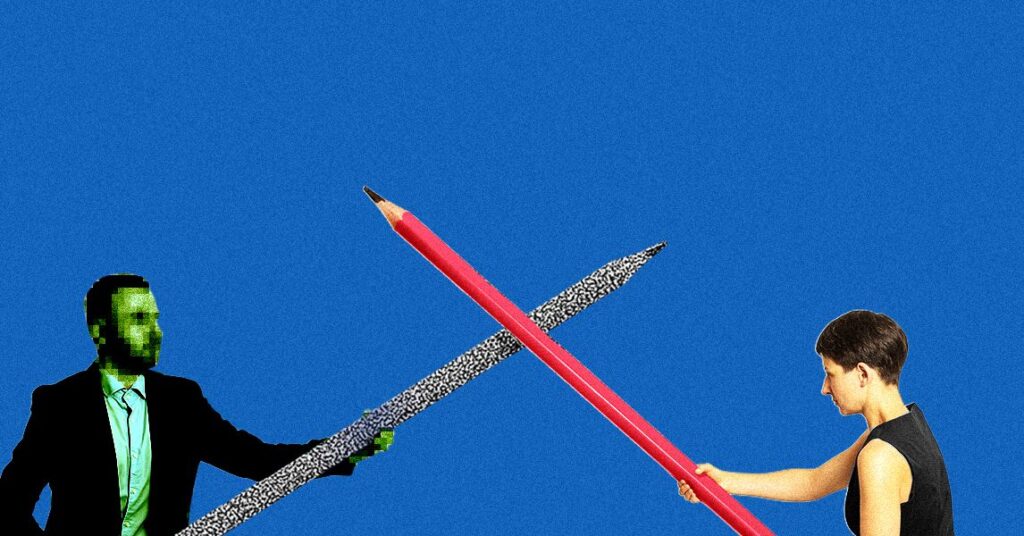
Last year, when novelist Laura Brooke Robson started crafting Love Is an Algorithm—a romance between an AI dating app cofounder and a musician navigating the era of large language models—she made a conscious effort to avoid sounding like AI herself.
Robson penned sentences she believes she wouldn’t have attempted prior to the rise of LLMs, steering clear of what she terms “wishy-washy metaphors,” and opted for “a more winding path to sidestep an em dash or a tripartite list.”
She asserts that since LLMs became commonplace, her writing has transformed for the better, becoming a purposeful contrast to what she perceives as AI’s inherent lack of style.
“I notice I’m writing less mechanically,” she shares. “I feel compelled to include small errors, like winks to the reader, to signal that a human is behind the words. It’s like: What if I just coined a phrase? What if I did something surprising with punctuation?”
Robson is part of a broader group of writers adopting what could be termed an anti-AI writing style. In various fields, including journalism, criticism, creative writing, and among the frequent LinkedIn posters, writers are leaning towards choices that subtly defy the conventions of AI-generated text.
This style primarily emerges through negation, often steering clear of evident AI markers such as lists of three, passive voice, not x but y, and em dashes. Yet, it also values idiosyncrasies as a core principle, drawing on personal anecdotes and unique similes that reflect the arduous process of writing.
“I believe AI could genuinely inspire a literary counterculture,” Robson states. “It seems literary fiction will drift even further towards the odd and esoteric as personalization takes over commercial fiction.”
In the publishing industry, concerns regarding AI have unsettled authors. In March, Hachette retracted Mia Ballard’s horror novel Shy Girl amid online speculation that she had heavily relied on AI, a claim she denied. Ballard, who has upcoming writing projects, has had to rethink her approach. “Ensuring my writing feels real and authentic is my top priority,” she says, emphasizing the importance of editorial integrity after her previous editor used AI software on her manuscript. “That’s what caused issues the first time.” Hachette did not respond promptly to a request for comment.
Similarly, Steven Rosenbaum’s book The Future of Truth, which explores “how AI transforms reality,” was said to contain several fabricated quotes generated by AI, a claim Rosenbaum later confirmed.
Ellena Savage, an Australian author and academic whose writing is influenced by Victorian literature’s complex-compound sentences, expresses regret over being affected by thoughts of chatbots. “AI has appropriated several syntactical conventions I once cherished. I miss using the em dash liberally. I long for the rule of three, which brought such satisfaction. What now—the rule of two? Five? Seven? Ten?”
Throughout magazines and digital outlets, this anti-AI counterstyle is also influencing internal style and editing practices. Richard Fisher, an honorary professor at University College London and an editor at the online culture magazine Aeon, mentions that AI has encouraged him to inspire writers “to be more human” and adopt a more conversational tone. “We don’t want to smooth out the rough edges because AI cannot create prose that is as spiky or unique as humans. While some writers may prefer to maintain their practices, others might feel compelled to adapt.”
Mano Sundaresan assumed the role of Pitchfork’s head of editorial content in July 2024, around the time LLMs gained wider acceptance. With a background in blogging, he encouraged writers to find “their own voice,” something he reflects might have emerged from this AI shift. He and his fellow editors have since issued a memo stating that AI cannot be employed when submitting review copy while promoting first-person viewpoints. (Pitchfork is owned by Condé Nast, which also owns WIRED.)

Rajat Sharma
https://in.linkedin.com/in/rajat-mediaHelping D2C Brands Scale with AI-Powered Marketing & Automation 🚀 | $15M+ in Client Revenue | Meta Ads Expert | D2C Performance Marketing Consultant