Europe’s Frustration: A Call for Its Own AI Development
Earlier this month I attended Vivatech, a major tech conference held in Paris. A prevalent theme emerged in conversations: the anxiety of relying on American AI, shaped by American values. While the US and China are engaged in an AI arms race, France and Germany, confident in their engineering capabilities, feel sidelined. They are not only insisting on being heard but also promoting strategies to rectify the situation. If “sovereignty” were a keyword in a drinking game, you’d be intoxicated within three hours.
Throughout my decades of reporting on technology, I’ve witnessed numerous attempts by countries striving to duplicate the Silicon Valley phenomenon. Despite several individual success stories, no nation or market has approached the unique ecosystem and mindset that birthed companies like Google, OpenAI, and Anthropic. While investors pour vast sums into American companies, Europeans receive relatively meager funding. A striking statistic shared multiple times last week was that Anthropic’s recent $65 billion fundraising surpassed the total investment in AI startups across Europe and the UK last year. Reports from the EU seem to confirm this disparity.
Nevertheless, the discussions around sovereignty at Vivatech were filled with optimism. Advocates highlighted promising new investments, collaborative initiatives, and next-gen technologies that could potentially be less resource-intensive than existing large language models. Additionally, several pointed to an unexpected factor that might benefit European tech significantly: Donald Trump.
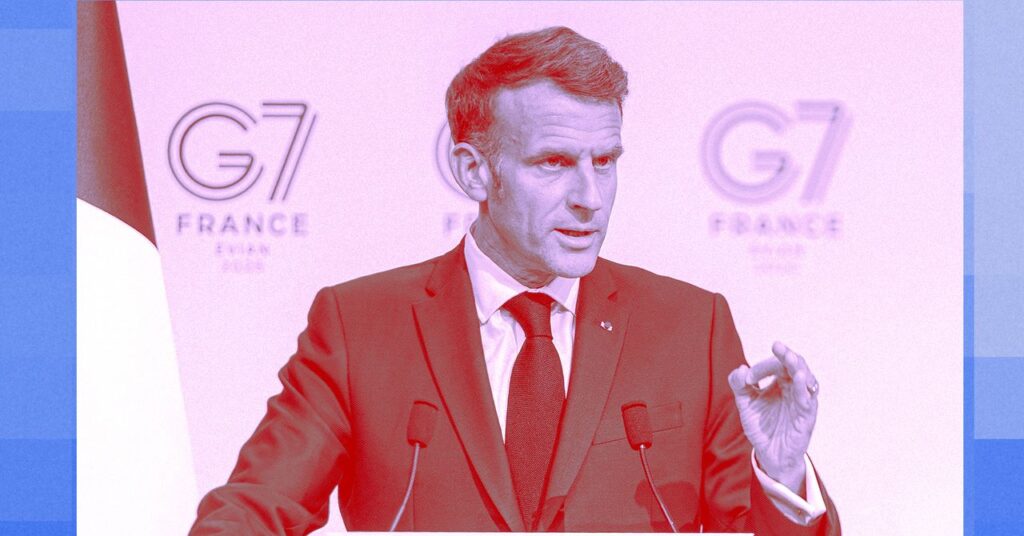
Vivatech coincided with the G7 conference in Evian-les-Bains, France, where French president Emmanuel Macron addressed AI leaders about sovereignty. He asserted that if the US continued its path of nationalistic AI, France would consider forging its own path. Aiden Gomez, the CEO of Toronto-based Cohere, also attempted to express urgency to the audience in Evian. “We must ensure that a democracy holds the number two position, which isn’t the case right now,” Gomez told me at Vivatech. “I believe the G7 recognizes the necessity for a diverse supply chain of AI providers.”
It may sound overly ambitious for Europe to envision creating the world’s second-best AI. More than 20 nations would need to collaborate closely, overcoming bureaucratic hurdles that stifle innovation and attracting unprecedented levels of investment. Above all, Europe must transition from a risk-averse mindset to one focused on moonshot objectives. However, Macron has made some strides. His “Choose France” initiative has secured commitments exceeding 100 billion euros for AI infrastructure, highlighted by Softbank’s 75 billion-euro promise to establish large data centers in France—subject to approvals, of course.
Regarding partnerships, Gomez reveals that Cohere is working to weave a multinational network of collaborations, starting with a partnership with the German AI company Aleph Alpha. This endeavor aims to consolidate resources in engineering and infrastructure for a “sovereign-first” strategy. “A few weeks ago, I was with the king of Spain to sign an MOU with Indra, Spain’s largest tech firm,” he notes.
Yann LeCun, the AI pioneer who recently stepped down as Meta’s chief AI scientist, is leading Project Tapestry, an ambitious initiative uniting governments and private sectors to collaboratively develop a state-of-the-art foundational model. “Governments worldwide aspire to achieve AI sovereignty,” he states. “I see this occurring only if there is an open, free foundation model that allows anyone to create their own specialized assistant for their language, culture, value system, and political beliefs.”

Rajat Sharma
https://in.linkedin.com/in/rajat-mediaHelping D2C Brands Scale with AI-Powered Marketing & Automation 🚀 | $15M+ in Client Revenue | Meta Ads Expert | D2C Performance Marketing Consultant